The Astrologer and the Anima Mundi
Much ink has been spilled on the topic of whether or not astrology works. The pseudo-scientific materialist skeptics insist that astrology does not, cannot, and must not work. The astrologers insist, sometimes with equally pseudo-scientific arguments, that astrology works, although they don’t know how or why. Ever since astrology lost its place among the star-studded ranks of the natural sciences, and since the church joined ranks with the skeptics to discard the last shreds of the grand medieval image of the universe, astrologers and skeptics have seemed content to repeat this argument. Yet the argument from astrology, as such, seems unsatisfactory. It may not be possible to determine why astrology works; it should be quite possible to come up with a model of how astrology works.
In fact, this model already exists. The philosophical model of the world which was discarded by the Enlightenment and quietly continued by occultists contains, among much else, an explanation for how astrology works. This is readily accessible to any interested student of occultism or astrology, but as it seems little-known in the greater community of people interested in astrology, there is some room for a brief introduction to the subject.
Astrology, as I’ll define it, is the study of planetary vibrations and their effects on consciousness. (The traditionally-minded astrologers among my readers may disagree with such a definition; to such readers, I ask you to consider it for the sake of argument.) A vibration, much like the impression the word may give, is a vibe: have you ever entered a place and immediately felt that something terrible had happened there, or gotten caught up in the atmosphere of a group, or felt someone’s eyes on your back? That was a vibration, which you sensed through some non-physical means, but which left a real impression on you all the same. According to occult philosophy, the medium through which you experience vibrations is a subtle energy called variously by such names as the life force, qi, magnetism, etheric energy, and the astral light.
The Sun continually emits, in addition to ordinary heat and light, astral light, which descends through the solar system to the Earth. The astral light is highly sensitive to vibrations, and any strong spiritual force tends to leave traces in it, just as a stone dropped in water leaves ripples spreading outwards in its wake. The planets, according to occult cosmology, embody spiritual forces of great power, and their movements form patterns in the astral light which in turn affect consciousness on Earth.
The life force emitted by the Sun sustains all living things; it is the spirit which connects your body and your soul. In Renaissance philosophy, these are called spiritus, corpus, and anima. Whenever you move your body, or corpus–perhaps to pick up a cup of tea–your rational mind, or anima, first creates a pattern of thought corresponding to the idea, and your spirit carries out that pattern and moves your hand according to your will. The world is also a living being, and it has a corpus, spiritus, and anima just like you do. The Corpus Mundi is the material body of the world, which corresponds to all physical matter. The Spiritus Mundi is that subtle body of the world which corresponds to the web of the life force flowing through all living things. The Anima Mundi, then, is the rational soul of the world. The currents formed in the astral light by the planets become patterns in the vast consciousness of the Anima Mundi. Through Spiritus Mundi, these patterns descend into material reality and take shape in the bodies of all living things. Just as the life force flowing through you moves your hand in accordance with your desire to take a sip of tea, so do the thoughts of the Anima Mundi influence all life on Earth accordingly.
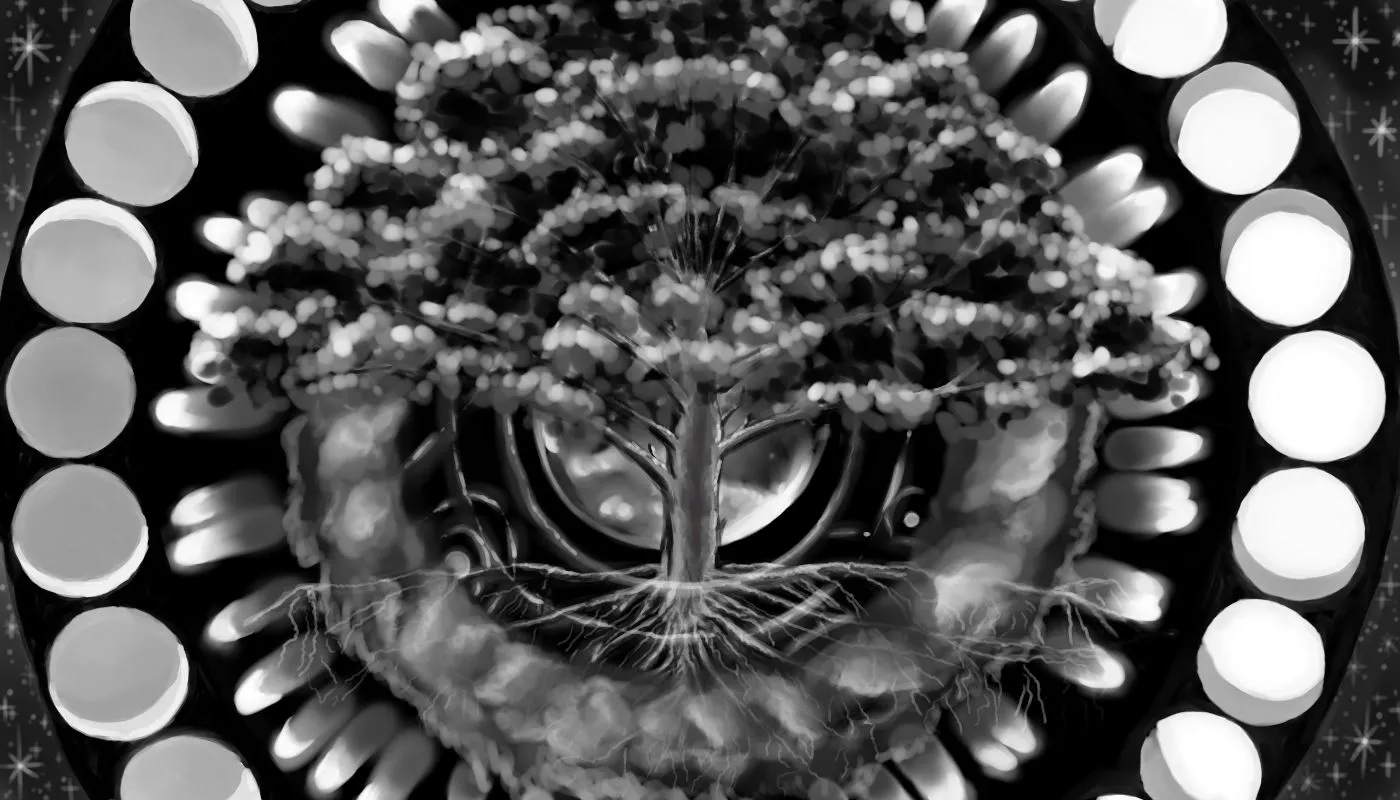 The Anima Mundi extending through the spheres of geocentric cosmology.
Yet this influence extends both ways. When you inadvertently touch a boiling hot kettle, your body recoils without your conscious input. So too do our actions flow outwards and influence the world in turn. Spiritus Mundi, far from being static, is the interface between us and the world. Similar ideas are restated many times by early 20th century astrologers which describe the world as being made of one substance and one thing. Because all influence passes through Spiritus Mundi, which is properly speaking not a rational body, rational means are not useful for interacting with the world soul. Instead we must turn to irrational means, such as a set of symbols, each of which corresponds to an idea or concept. These symbolic languages form various divinatory systems, of which astrology is one.
To recap, then, the movements of the planets form disturbances in the astral light, which are reflected by patterns in the Anima Mundi. Through Spiritus Mundi, these patterns influence all life on Earth according to their nature. By means of the symbolic language of astrology, the astrologer interprets these patterns and their likely manifestations.
Unlike most other divinatory systems, astrology is based on a deterministic set of patterns. Everyone pretty much agrees on where in the sky a planet is at any given moment, and we’ve learned to calculate their past and future movements with a high (but not perfect) degree of accuracy. The natural conclusion is that certain patterns in the Anima Mundi are essentially predestined to occur. Indeed, astrology has always been accused of being a fatalistic discipline, and not without due cause. Yet the objective reality of planetary positions does not necessarily determine how those energies are ultimately expressed. Astrologers have long noted that the same placements can manifest in radically different ways. The character-focused astrology which Alan Leo pioneered offers one explanation for this phenomenon.
As the idea goes, a planetary vibration carries the potential for either positive or negative expression depending on one’s state of spiritual advancement. A difficult Mercury-Mars square might, for example, manifest as an inability to communicate without starting a fight, or as a miscommunication which ultimately works out well, depending on the level of spiritual maturity which the person expressing the aspect has attained. These are standard ideas in Theosophy and in most other parts of esotericism which were influenced by it.
So far as I have been able to tell, this concept is not present at all in astrological writers much older than Alan Leo, who enthusiastically incorporated Theosophical opinions into astrology. The fact remains that, in my experience, I have found it to be completely accurate. Certainly, someone who spends a great deal of time in spiritual practice is likely to be more resilient under difficult circumstances. The results of regular spiritual practice, however, do seem to alter the typical expression of a natal chart in certain minor ways. Whether or not this always worked, whether it works for everyone, or whether it works now but did not in the past, touches on speculations which are outside the scope of this post.
Still, granting that Leo was right and that one’s own state of consciousness–whether one is resonating with negative or positive spiritual frequencies–has an impact on the specific expression of an aspect, there are a few things which ought to demonstrably be the case. It may be possible to ground a hard transit from being excessively damaging by acknowledging the difficulty and considering it an opportunity for spiritual growth. It may also be possible to get more spiritually out of an easy transit by turning down a material opportunity and instead pursuing the same energies in a higher expression. I consider this process to be similar to, if not identical with, the process of raising one’s spiritual vibrations. There is a great difference in reacting to an event with anger or badly concealed ill-humor, and in approaching it as a learning experience or in any number of more positive ways.
For those who wish to join me in exploring this idea, I propose a simple experiment. Consider your next transit (or other predictive technique) as a thought in the mind of the Anima Mundi. Under what circumstances might someone think this thought? In what way do your own actions and habits express it in the realm of ordinary life? Make a note of your conclusions along with your prediction, and after the transit passes, look back to see if your reflections altered how you might have ordinarily reacted to it.
If our influences do, in fact, filter back up through the Spiritus Mundi through our actions, and if the world has a body, spirit, and soul just like us, then it stands to reason that this state of affairs is very much like talking to a person, and that we will get further by approaching the Anima Mundi as a person than otherwise. By our actions, we communicate our true desires. Consider wisely what you are saying to the universe, then, because the universe may just answer you.