Balancing the Planets
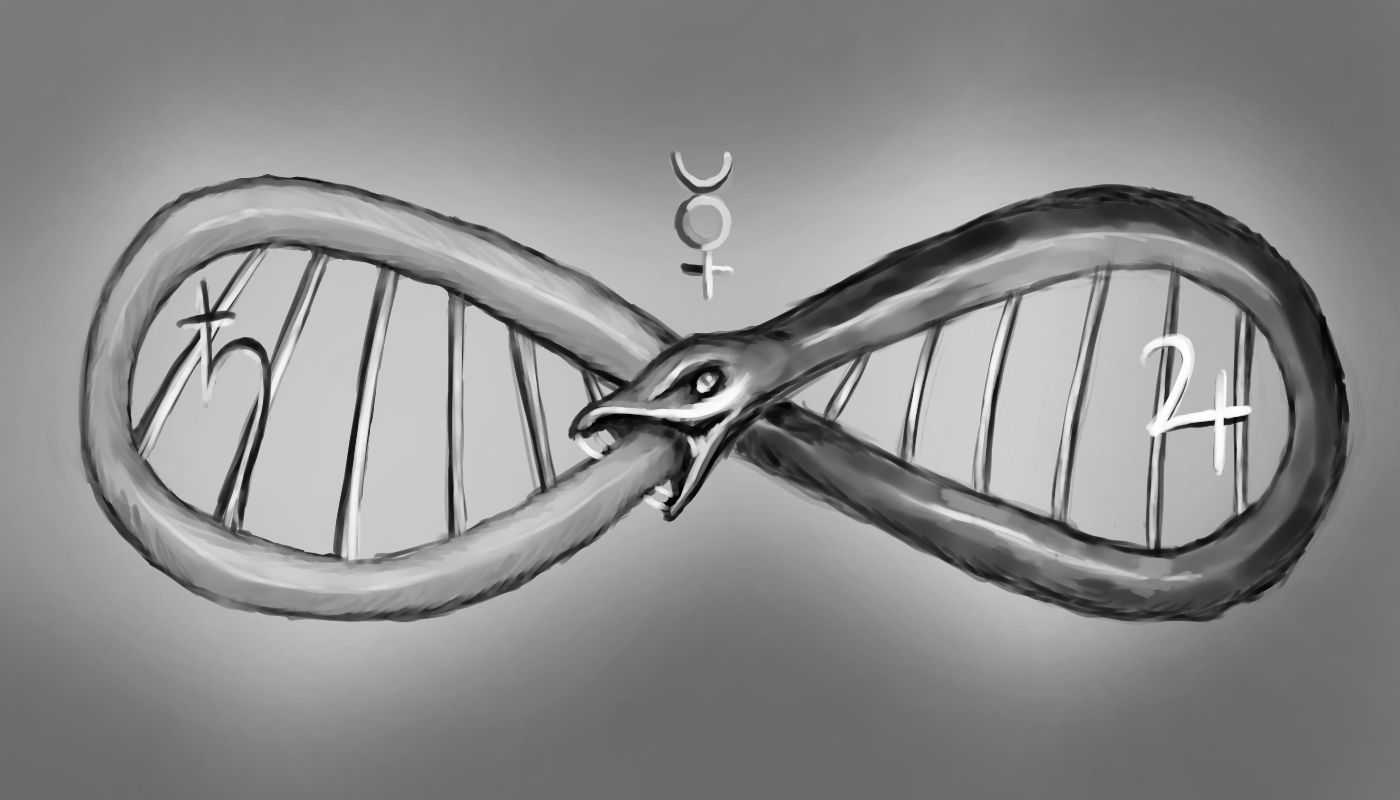
One of the first things anyone learns when they begin to seriously study their own chart is that, if they’re like most of us, they have a mixture of good and bad aspects. The good aspects are pleasant when they’re activated, and the bad aspects–well, sometimes they’re slightly obnoxious, sometimes they’re excruciatingly difficult, and most of the time they’re somewhere in between. Reactions to this fact have varied about as much as philosophy, ranging from a resigned acceptance of the things one can’t change to a blithe insistence that bad aspects are really transformative potentials for growth. As anyone who observes their transits or casts horary charts for long enough finds out, when Mars in his fall in the 8th squares the lord of the Ascendant and Uranus witnesses the configuration from the 6th house, sometimes a bad aspect isn’t transformation or potential for spiritual growth; sometimes it’s skinning your knee open in a gardening accident and being happy it wasn’t worse.
There are, of course, more useful approaches than either of these extremes. One of them involves the idea that two planets in a bad aspect–or any aspect–represent different forces competing for influence in your psyche. Make those influences conscious, and you’ll be able to balance them against each other in a process of harmonious change. As far as I know, this idea has its origin in modern astrology–you won’t find much support for it in traditional astrology. Most of the traditional explanations I’ve read for why an event in a native’s life turned out better or worse than an expected delineation revolve around using more detailed techniques. There is something to be said for this, as any chart contains an infinite variety of possible interpretations, and it’s always possible to miss some subtlety of detail. Still, since there’s a lot about astrology which we don’t understand, it seems that resigning one’s fate to any particular interpretation is rather equivalent to putting all one’s investments in a single stock. If you can do something about the expression of your bad aspects, why wouldn’t you?
Strange as it may seem, for much of the time when astrology was practiced, this reasoning would have been theologically and socially unacceptable. Crack open a copy of the Iliad and you’ll see why: Homer’s gods quarrel, scheme, take sides, and generally act much like the mortals they’re involved with. It’s worth taking a closer look at who precisely among the gods are the major players: Thetis, Zeus, Apollo, Athena, Aphrodite, Hera, and Ares, to name a few. Some of them are quite familiar when Latinized into their Roman equivalents: Jupiter, Venus, Mars, and Sol (as Helios syncretized with Apollo). All that’s missing are Saturn and Luna to round out the set; Mercury, or Hermes, appears a little later on. Yes, that’s most of the classical seven planets represented, and intriguingly, the disagreements among the gods bear some resemblance to good descriptions of various aspects; try reading Apollo’s alliance of convenience with Ares as a description of Sun right sextile Mars sometime.
This isn’t the only place where astrology gets mixed up with mythology, although the Greek or Roman names certainly are easy to identify. Turn to a copy of the Bible and read any description of Judah as the lion among the twelve tribes of Israel as the zodiacal sign of Leo–or the significance of Christ, being of Judah’s bloodline, having twelve disciples. The Sun rules Leo, and so does the Son born from Judah rule the twelve and the Gentiles who are as multitudinous as the fishes of the Piscean age. If neither Greek nor Christian mythology piques your interest, you’ll find similar astrological symbolism written everywhere, particularly among the Mayans and the Babylonians.
Here it’s worth saying that the map is not the destination, and the gods are not, as far as most Westerns traditions hold, precisely the same as the stars which bear their names. The distinction is usually made in the earliest Greek and Roman astrological writers, who referred to the planets as the stars of their associated gods, not as the gods themselves. This technical subtlety survived in occultism as the distinction between the planetary intelligences and the gods of classical polytheism. That said, this is one area where there may be reasonable disagreement.
Many ancient civilizations devoted quite a bit of time and effort to astrology and to astronomical observations; back then it was more or less a distinction without a difference. If we consider that, to these ancient men and women, the Sun, Moon, and visible planets were–as the Neoplatonists might put it–the living bodies of gods, or gods in their own right, the long history of astrology takes on additional significance. The will of the gods is written in the stars, for those dedicated and observant enough to read it. The efficacy of astrology is further interpreted as evidence of the will of the gods playing out to inevitable fate.
It’s difficult for modern minds to fully understand this mode of thought. To our default perceptions, the movements of the stars provide the physical basis for spiritual interpretation. For a very long time, the default perception was that spiritual reality came first, and the physical motions of the planets were manifestations of that divine reality. And yet those manifestations are far messier and less perfect than anyone in the Middle Ages thought. Since Ptolemy, astronomers had been convinced that the planets moved in perfect circles, and piled up increasingly absurd calculations to prove that fact. Everyone knew that the planets basically moved in circles; they must, for the circle is the symbol of heavenly perfection. Except, as Kepler showed, planetary orbits aren’t circular at all, but elliptical. And as it turns out, they’re far more irregular and complex than even Kepler’s straightforward laws asserted. Even with our current models, it’s impossible to predict planetary motion indefinitely into the future or past. At some point, theoretically perfected motion of the heavens gives way to manifest earthly imperfections. This modest theory represented the beginnings of a spectacular shift in thinking about the cosmos and our place within it.
The most fascinating thing about all of this is that the old model didn’t go away. It continued to coexist with new models of thought, quietly, mainly kept alive by eccentrics and occultists who kept on using the old geocentric scheme of the universe. The practicing mage is perhaps the only person more ruthlessly practical in the furnishing of his brain-attic than Sherlock Holmes. Either something works, or it doesn’t, and a successful mage keeps what works and discards what doesn’t. Clearly the old model of the universe still works, and works well, since occultists from Agrippa and onwards have kept using it.
The traditional way of appeasing badly dignified or afflicted planets is via planetary charity. This is a fairly simple practice; the core of it is that you choose a planet and make a donation, either of time or money, in the day and hour of that planet, for a number of times which traditionally corresponds to the planet. Unlike some other forms of planetary remediation, it’s relatively safe and works quite well–regardless of one’s opinions about the nature of the planets.
For those of us who aren’t inculcated in traditional Renaissance cosmology, however, it’s hard to deny that the way we relate to the universe has changed. It stands to reason that if the new, post-Kepler, view of the planets works, then it ought to also have some way of dealing with bad aspects. Just as traditional astrology has planetary charity, modern astrology has also developed a similar technique, which is complementary to and does not replace the older model. As I mentioned at the beginning of this post, it involves making the influences of the planets conscious and balancing them against one another. When you make the unconscious conscious, it ceases to have power over you. When you gain power over your own consciousness, you become able to choose how you react to external impulses. In short, it’s the transformation of fate into free will.
Delineation is the first and easiest step. Once you’ve delineated the planets involved in an aspect individually, the next step is to meditate or journal on how they’re expressed in your life. This is the core of the practice and should not be rushed. Every placement has both negative and positive qualities; once you’ve meditated sufficiently, you ought to be able to decide which of those expressions you like and which you’d prefer to minimize. Bringing these possibilities into conscious awareness gradually expands the range of your possible reactions to situations.
Is it as simple as awareness? Not exactly. If you try to actively choose the planetary influences you want in certain contexts, you’re likely to get unwanted expressions in other contexts. There’s another consideration to making the most of this technique, and it comes from a Hermetic text named The Kybalion and written by Three Initiates, who were one person named William Walker Atkinson (who may or may not have been thrice initated), and which has nothing to do with the ancient Corpus Hermeticum. (It’s my opinion that Hermes would heartily approve of such misdirection.) For every action, there is an equal and opposite reaction: Atkinson adds the subtlety that the reaction happens on the plane lower than the one on which the action occurred. This is called the Law of Neutralization, and the mage takes advantage of it by taking action on a higher plane than the one on which the corresponding reaction is desired.
The Law of Neutralization isn’t difficult to apply to balancing astrological aspects, though it does take practice. In my experience, when two planets are in a difficult aspect, an action of the nature of the first planet is very likely to have a reaction of the nature of the second aspect. The energy from this action-reaction cycle may be directed to a place which is equidistant to or harmonious with both of them, and there is usually some choice in where the energy lands. Specific actions and reactions, as well as the most beneficial contexts in which to perform them, are determined by meditation on one’s natal chart.
As in most astrological practices, timing is key. It doesn’t do much good to deliberately create a reaction if the resultant energy has no opportunity for outlet. Likewise, indulging the flaws shown by a bad placement are likely to result in an equally negative backlash from a competing influence. Meditation and observation can take this practice far. The reward of all this work in paying attention to unconscious forces is a great deal of energy channeled productively towards the goal of your choosing.
A word to the wise: if you approach this practice with the desire to bring your inner and outer circumstances into harmony, the results can be very pleasant. If, however, you are trying to force your unconscious into shapes that your chart does not support, the backlash will be difficult. Take your entire chart into account, not merely the aspect you are working, and have fun.